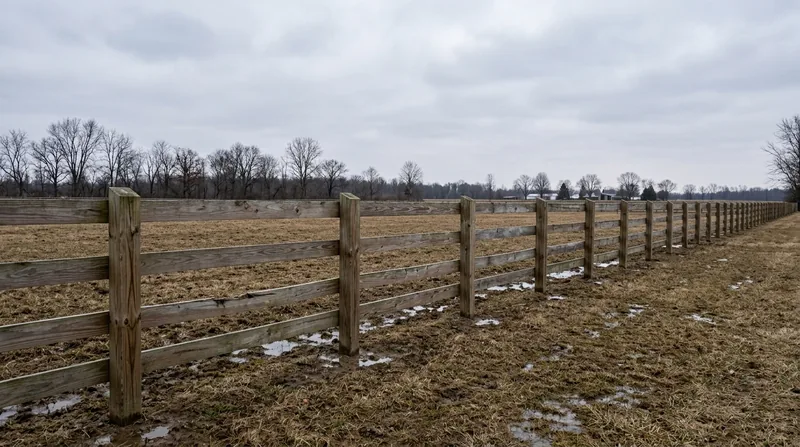




Farm fence installation in Columbus requires more than standard residential fencing know-how. Greater Columbus sits in Franklin County, where acreage properties face dense clay soils and deep winter frost that can heave posts and destabilize rail sections if they're not set properly below the frost line. Whether you're installing woven wire for livestock containment, split rail for open pasture, no-climb horse fence for equestrian properties, or pipe fence for durability, the installation method and material choice directly affect how long your fence stands and how much maintenance it demands over time. Columbus Fence Installers has worked on farm and ranch properties across the region since 2013, and we understand the difference between residential fence work and the structural demands of acreage fencing. We work from the customer's property line and existing survey, and we handle the full scope: post setting below frost depth, proper bracing for span and load, and materials rated for the exposure your land sees.
Why Farm & Ranch Fencing Matters in Greater Columbus
Acreage properties in Columbus and surrounding areas need fencing that handles livestock containment, property definition, and long-term durability without constant repair. A poorly installed or undersized fence fails within a few seasons; a well-built one protects your investment and your animals for decades. The soil and frost depth in Franklin County demand posts set deep and concrete-set for stability, not just tamped earth. Material choice matters too: pressure-treated wood rail resists rot at the ground line, woven wire mesh needs proper tension to prevent sagging, and pipe fence requires galvanized or powder-coated finish to stand up to moisture.
- We install wood rail fencing (split rail and ranch-style) set below the frost line for stability on acreage.
- Woven wire and no-climb horse fence systems are tensioned and braced to prevent sagging and maintain containment.
- Pipe fence is galvanized or powder-coated and set in concrete for long-term durability on open pasture.
- Post spacing and rail configuration are sized to the terrain and the animals or use case your property requires.
- We handle barbed wire installation where appropriate, with proper post height and spacing for livestock control.
Each material and method serves a specific purpose, and choosing the right one upfront saves thousands in repairs down the line.
Key info: Acreage fencing in Grove City, Worthington, and Hilliard often requires property line verification before installation begins. We work from your existing survey and identify the fence line with you before we set a single post. If you don't have a current survey, a licensed land surveyor is the only person who can determine your boundary officially.
For more details on how we approach property lines and installation standards, see our full fence repair and installation guide.
How We Install Farm & Ranch Fencing in Columbus: Step by Step
Farm fencing installation is a deliberate process. We begin with a site walk to assess soil condition, drainage, slope, and any obstacles like trees or rock outcrops that affect post placement and rail routing. We call 811 for utility locates before we dig any post holes, a legal requirement in Ohio. Posts are set below the frost line (depth determined by local soil and exposure), and we use concrete-set installation for posts that carry load or span open ground. Rails are cut and fitted to the terrain, either stepped on sloped land or racked where the ground angles, and tension is applied to mesh or wire to prevent sagging. Bracing is added where spans are long or the fence must resist livestock pressure.
- We conduct a site assessment to identify obstacles, drainage patterns, and the best post and rail routing for your acreage.
- We call 811 to locate utilities before digging, a legal requirement that protects you and us from costly damage.
- Posts are set below the frost line in concrete for stability on acreage where frost heave is a real risk.
- Rails are cut and fitted to the terrain, stepped on slopes and side-by-side on level ground, with proper spacing for the span and load.
- Mesh and wire are tensioned using stretcher bars and tension bands, and anti-sag bracing is installed where needed to maintain alignment.
- We finish with caps and trim where the design calls for it, and we walk the perimeter with you to confirm the work meets your expectations.
This methodical approach ensures your fence performs as intended and stands for years without premature failure or sagging.
Example: A 15-acre property in New Albany with rolling terrain and clay soil needs split rail fencing along the north boundary. We set posts 8 feet apart below the frost line, fitted the rails to the slope using a stepped installation, and added cross-bracing to resist settling. The job took 5 days and cost $4,200 for 350 linear feet. Three years later, the fence has not heaved or settled, and the owner has had no repairs.
Learn more about our post repair and replacement services if you have an existing fence that needs maintenance.
Farm & Ranch Fencing Methods and Materials
| Fencing Type | Description | Best For |
|---|---|---|
| Split Rail Fence | Pressure-treated or cedar rails mortised into posts, set below frost line, stepped or racked to terrain. | Open pasture, property definition, aesthetic appeal on acreage in Upper Arlington, Bexley, and Worthington. |
| Woven Wire Fence | Wire mesh tensioned between posts using stretcher bars and tension bands, with anti-sag bracing on long spans. | Livestock containment, equestrian use, areas where climbing or jumping is a concern. |
| No-Climb Horse Fence | Woven wire or rigid mesh with small openings (2x4 or 2x6 inch), preventing hooves from catching and horses from climbing. | Equestrian properties, pastures with valuable animals, high-risk areas where escape or injury is a concern. |
| Pipe Fence | Galvanized or powder-coated steel pipe set in concrete, welded or bolted at joints, extremely durable and low-maintenance. | High-traffic areas, pasture boundaries, long-term installations where durability and appearance are priorities. |
| Barbed Wire Fence | Multiple strands of barbed wire strung between posts and tensioned, typically 4 to 6 strands depending on livestock type. | Cattle and livestock control on open acreage, perimeter boundaries, cost-effective solutions for large properties. |
Each method has a place in farm and ranch work. The right choice depends on your animals, terrain, budget, and long-term maintenance tolerance.
Farm & Ranch Fencing Cost in Columbus: What to Expect
Farm fence installation pricing in Columbus starts at around $13 per linear foot for basic split rail or woven wire on level ground with good access. That baseline moves up based on several concrete factors: terrain (stepped installation on slopes costs more than side-by-side on flat ground), soil condition (rocky or clay-heavy soil takes longer to dig), material choice (pipe fence costs more than wood rail but lasts longer), span length (longer spans between posts require additional bracing), and the complexity of the property line or obstacles. A small acreage with straightforward access and level terrain might run $12 to $15 per foot; a hilly property with difficult soil or long spans can reach $18 to $22 per foot or higher. We recommend getting 2 or 3 estimates from different contractors, because pricing varies based on crew availability, material sourcing, and the specific site challenges each contractor identifies.
Travel within Columbus and surrounding areas is included in our pricing, with no separate mileage fee. For detailed pricing on specific materials and job sizes, visit our full pricing page.
Cost example: A 200-linear-foot woven wire fence with posts set below the frost line on a property in Pickerington with moderate slope and clay soil runs approximately $2,400 to $3,000, depending on post spacing, bracing requirements, and whether you choose galvanized or powder-coated hardware. A 350-linear-foot split rail fence on level ground with good access costs $4,200 to $5,250. Barbed wire on open pasture (4 strands, 6-foot post spacing) costs $8 to $12 per foot, making a 500-foot run roughly $4,000 to $6,000.
Farm & Ranch Fencing Near Me: What Columbus Homeowners Should Know When Hiring
Hiring the right contractor for acreage fencing in Columbus, Gahanna, Canal Winchester, or other Franklin County communities means checking three critical things: insurance, licensing rules, and references. First, confirm the contractor carries general liability and workers' compensation insurance and can provide a certificate on request. Second, understand that Ohio issues no state license for fence installation; licensing and registration are set city by city, and requirements vary across Greater Columbus. Ask your local building department whether a permit is required for your property and whether the contractor must be registered with the city. Third, ask for references from acreage or farm projects they've completed, and call those customers to ask about the fence's performance over time, whether it has heaved or sagged, and whether the contractor stood behind the work if issues arose.
- We are fully insured with general liability and workers' compensation cover, and we provide a certificate of insurance on request.
- Verify permit requirements with your local building department before work begins; rules vary across Columbus, Worthington, Hilliard, and other jurisdictions.
- Ask whether the contractor has completed similar acreage projects in your area and how those fences have performed over 3 to 5 years.
- Check that the contractor calls 811 before digging and has a process for identifying and protecting utility lines.
- Confirm the contractor understands frost depth and soil conditions in Franklin County and has experience setting posts below the frost line.
- Get the estimate in writing, including material type, post spacing, bracing, and the total linear footage and cost.
Taking time to vet the contractor upfront protects your investment and ensures the fence performs as intended for years to come.
Ready to get started? Contact us for a free, no-obligation estimate. We respond within 24 hours and can walk your property to discuss the best approach for your acreage.
Farm & Ranch Fencing in Columbus: Pricing Guide
| Service | Price | Details |
|---|---|---|
| Split Rail Fence | Starting at $13/ft | Pressure-treated rails mortised into posts, set below frost line, stepped on slopes or level ground |
| Woven Wire & No-Climb Horse Fence | Starting at $14/ft | Wire mesh tensioned between posts with stretcher bars and anti-sag bracing for livestock containment |
| Pipe Fence | Starting at $18/ft | Galvanized or powder-coated steel pipe set in concrete, welded or bolted, extremely durable for pasture boundaries |
| Barbed Wire Fence | Starting at $9/ft | Multiple strands strung and tensioned between posts, cost-effective for large acreage and cattle control |
| Complex or large acreage install | On estimate | Hilly terrain, difficult soil, long spans, or obstacles require site assessment before final pricing |
| Free estimate | No obligation | Response within 24 hours at (380) 207-2032, includes site walk and material recommendations |
Indicative pricing, the exact cost depends on square footage, finish, and site access. Free personalized estimate within 24h at (380) 207-2032.


